

PARIS (CN) - When former French President Nicolas Sarkozy took the stand in his campaign financing appeal Thursday morning, one question made the courtroom fall silent.
"What is the nature of the respect that you have for justice decisions?" asked lawyer Vincent Ollivier, who represents families of victims from a Libya-backed plane bombing in 1989.
"I don't understand the nature of your question," replied Sarkozy, accused of accepting million in political funding from the late autocratic Libyan leader Moammar Gadhafi. "I'll reverse the question, what is your respect for justice decisions?"
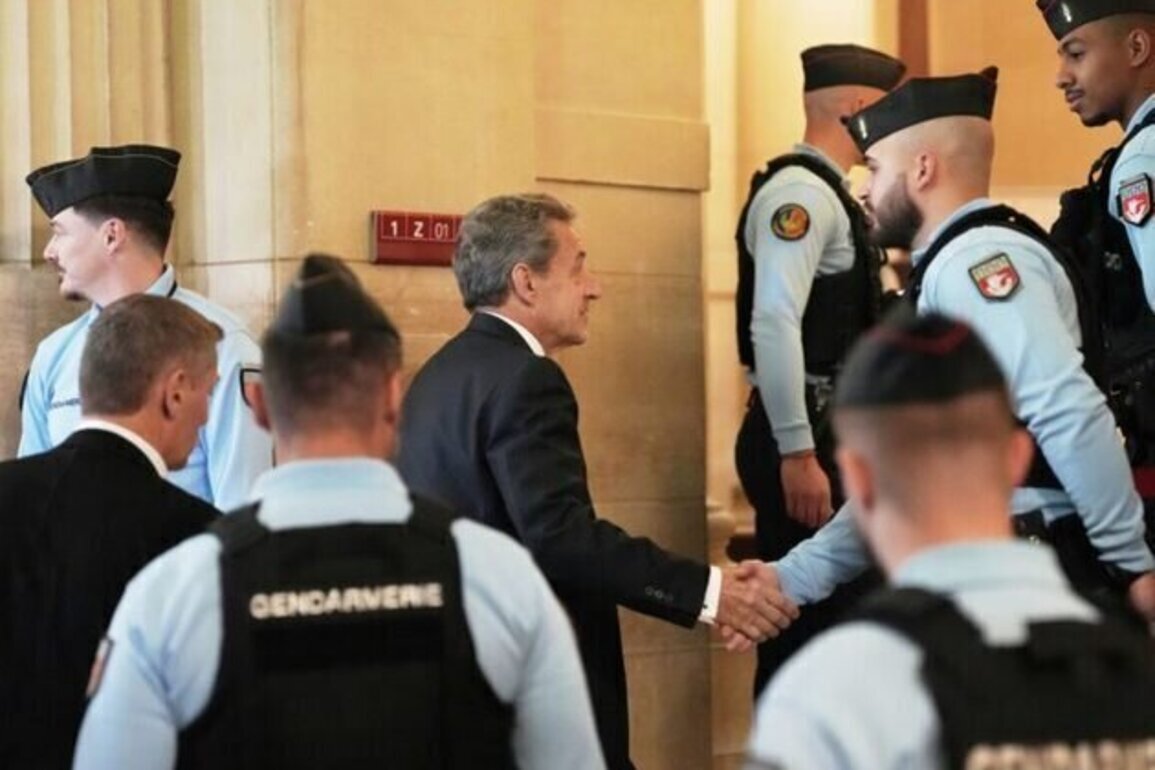
Sarkozy then launched into a rant about the case. He said that the roughly $58 million euros at the heart of the matter were never found. Nonetheless, he was convicted of criminal conspiracy on Sept. 25, 2025, and became the first French president to spend time behind bars.
After a brief but tense back-and-forth, Ollivier then invoked a statement that Sarkozy made when he left the courtroom after hearing the original verdict back in September 2025: "Hatred clearly knows no limits."
"I did indeed use the word 'hate,' but in my mind, it targeted certain people," Sarkozy said Thursday.
The former president said that he was more specifically thinking of Gadhafi; in previous hearings throughout the week, Sarkozy said that he believed the Libyan leader didn't like him and was out to get him. But he also said the statement applied to the National Financial Prosecutor's office, which "had made statements that seemed to me to be hardly legal and rather political."
Ollivier asked if Sarkozy was confounding his fate as a defendant with the fate of the country.
"I was president of the republic, that remains my honor, I am of course defending my person but I am also defending my country ... It was a way of saying that I had not betrayed my country," he said, raising his voice. "When a former president of the republic crosses the gates of La Sante prison, it is also a humiliation for his country."
Sarkozy was sentenced last year to five years in prison and a five-year ban on holding public office along with a $120,000 fine. Although his time in prison was cut short after 20 days, Sarkozy penned a book about his time behind bars, and "The journal of a prisoner" sold over 100,000 copies in the days following its release.
For experts, the affair highlights a broader, evolving tension between politicians and the justice system.
"The fact that a former president of a democratic country like France ended up in prison, and risks ending up in prison again, clearly shows the deficiencies that exist today," Gilbert Casasus, a prominent political scientist, said. "In a France where political power is truly no longer respected at all, because it also refused to respect judicial power."
The appeal has shown a shift in defense strategy from the original trial, when Sarkozy suggested that the judges were influenced by forces outside of the courtroom.
"He's no longer denouncing a politically motivated justice system that's supposedly designed to destroy him politically, but he's holding back and playing the good student in front of the justice system," Pierre Allorant, historian and political scientist at the University of Orleans, said. "He's saying, 'But I had nothing to do with it, these are just suspicions, and that's it ... My two colleagues made a mistake, and I had nothing to do with it.'"
Allorant was referring to Claude Gueant and Brice Hortefeux, two former Interior Ministers who were also convicted in the case. Throughout the hearings, Sarkozy repeatedly stated that he wasn't aware of secret meetings between the pair and highly controversial Libyan figures, which prosecutors said established the cashflow from Libya into Sarkozy's victorious 2007 presidential campaign.
In hearings throughout the week, Olivier Geron - the head judge on the appeal - continuously pressed Sarkozy about how he couldn't have known about the meetings, especially given their close relationships to Sarkozy. Gueant was his campaign manager, and Hortefeux was a longtime personal friend and minister.
On Thursday, Ollivier suggested that Sarkozy might have kept a hidden agenda between 2005 and 2007, leading up to his first campaign. The former president seemed agitated; he spoke slowly in a raised voice, emphasizing every word, recalling a very particular time in his life with no privacy.
"I was ... surveilled ... harassed ... by photographers, journalists during this exact period," he said. "All of my actions and words were already being scrutinized at that time, the 'hidden agenda' is an expression you can reserve for some of my successors, but for me, it wasn't possible."
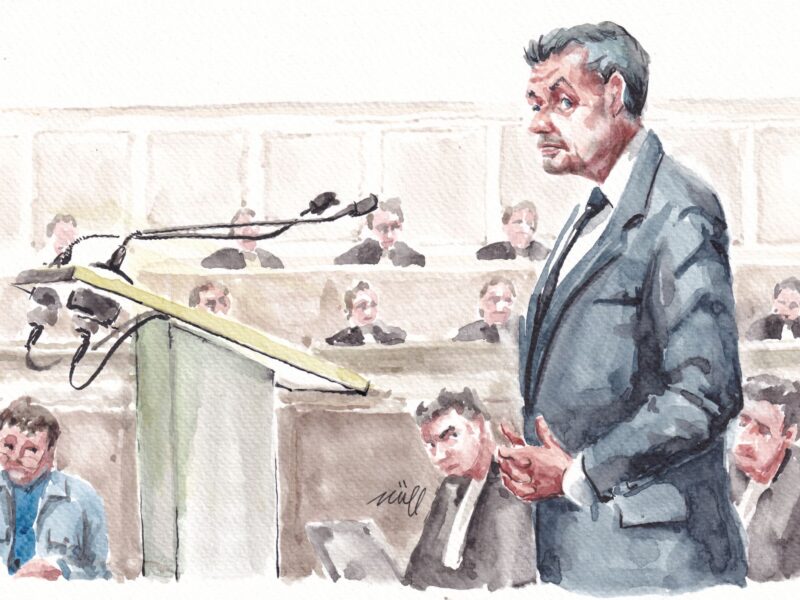
Lawyers probed Sarkozy for hours on Thursday, touching on subjects from Iranian hostages to Gadhafi and the credibility of witness testimony. But it was Ollivier's question about the justice system that made the audience perk up in their seats.
Throughout the past few years, the push and pull between politicians and the justice system has taken center stage in France.
This was fueled by the high-profile embezzlement trial of the extreme-right leader Marine Le Pen, who was found guilty and banned from running for public office for five years, threatening a potential 2027 presidential run. She had also likened her trial to a political witch hunt before shifting her defense strategy, similarly to Sarkozy.
Experts argue there's a bit of a catch-22 between holding politicians accountable to the rule of law, and making sure that it doesn't seem like the law is being unfairly used to punish political leaders.
"Now, if you ask for my purely personal opinion, I believe Sarkozy broke the law, the ties he had with the Libyan regime ... are now catching up with him, and there is not the slightest bit of compassion to be felt for Sarkozy in this matter," Casasus said. "On the other hand, I believe that if there is truly an overzealous pursuit of political power by the judiciary, we risk seeing a rhetoric of 'they're all corrupt' - the judges are corrupt, the politicians are corrupt - and this narrative has always favored the far right."
Source: Courthouse News Service